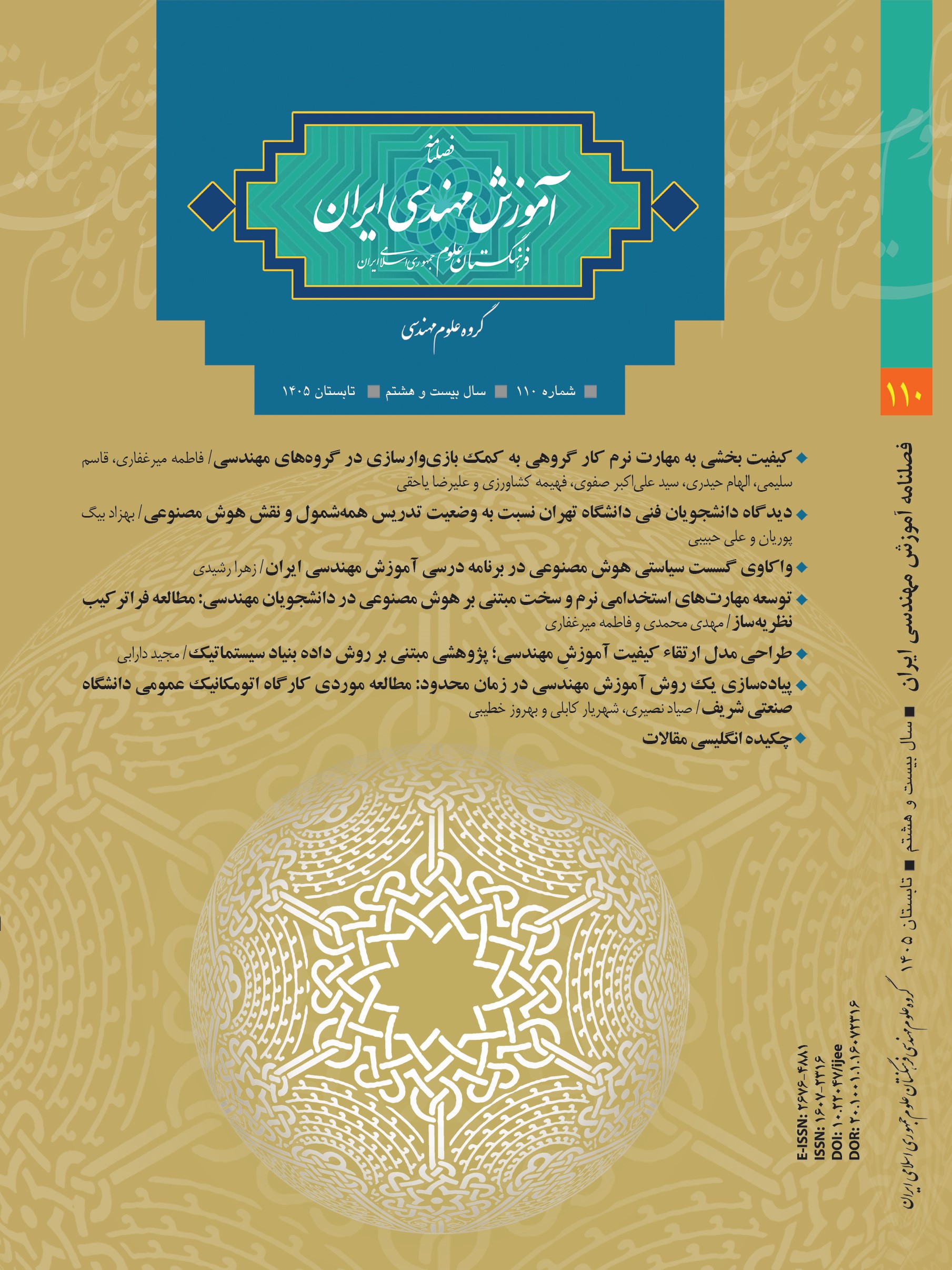
واکاوی گسست سیاستی هوش مصنوعی در برنامه درسی آموزش مهندسی ایران

نوع مقاله : مقاله علمی - پژوهشی

نویسنده

عضو هیات علمی گروه نوآوری آموزشی و درسی،موسسه پژوهش و برنامه ریزی آموزش عالی

10.22047/ijee.2026.585492.2254
چکیده
هدف این پژوهش واکاوی گسست سیاستی هوش مصنوعی در برنامه درسی آموزش مهندسی ایران و صورت‌بندی دلالت‌ها و پیشنهادهای سیاستی برای کاهش آن است. پژوهش با رویکرد کیفی و در چارچوب اَبَرانگارۀ تفسیرگرایانه انجام شد. داده‌ها از سه منبع مکمل گردآوری شدند: تحلیل اسناد بالادستی و سیاستی، مصاحبه‌های نیمه‌ساختاریافته با ۲۲ کنش گر کلیدی مرتبط با آموزش مهندسی در دانشگاه‌ها و دانشکده‌های فنی _ مهندسی تهران، و بررسی اسناد مرجع بین‌المللی در حوزۀ هوش مصنوعی و آموزش مهندسی. داده‌های اسنادی با تحلیل محتوای هدایت‌شده، داده‌های مصاحبه با تحلیل مضمون، و یافته‌های تلفیقی با منطق تحلیل شکاف و انتقال سیاست زمینه‌مند تحلیل شدند. یافته‌ها نشان داد که سیاست‌های رسمی، هوش مصنوعی را بیشتر در پیوند با توسعۀ فنّاوری، تربیت نیروی انسانی متخصص، مهارت‌آموزی و زیرساخت‌های رقمی/ دیجیتال صورت‌بندی می‌کنند؛ درحالی‌که تجربه‌های اجرایی کنشگران از اجرای پراکنده، ابهام در نقش‌های آموزشی، خلأ قواعد داده‌ای و اخلاقی، و کندی بازنگری برنامه‌های درسی حکایت دارد. تلفیق یافته‌های اسنادی و میدانی نشان داد که گسست سیاستی هوش مصنوعی در برنامه درسی آموزش مهندسی در چهار بُعد گفتمانی، پداگوژی، حکمرانی برنامه درسی آموزش مهندسی و زیرساختی _ داده‌ای قابل صورت‌بندی است. بر پایه این گسست‌ها و باتوجه‌به اسناد مرجع بین‌المللی، دلالت‌ها و پیشنهادهای سیاستی در سطوح کلان، میانی، خرد و عرضی ارائه شد. نتیجه پژوهش نشان می‌دهد که کاهش گسست سیاستی هوش مصنوعی در برنامه درسی آموزش مهندسی، مستلزم پیوند هم‌زمان میان سیاست‌گذاری، حکمرانی برنامه درسی، طراحی یادگیری و قواعد داده‌ای است.

کلیدواژه‌ها

موضوعات

عنوان مقاله English

EXPLORING THE POLICY GAP OF ARTIFICIAL INTELLIGENCE IN THE ENGINEERING CURRICULUM IN IRAN

نویسنده English

Zahra rashidi
Assistant Professor of the department of educational innovation and training, institute for research and planning in higher education, tehran, iran
چکیده English

The purpose of this study was to explore the policy gap of artificial intelligence in the engineering curriculum in Iran and to formulate policy implications and recommendations for reducing this gap. The study was conducted using a qualitative approach within an interpretivist paradigm. Data were collected from three complementary sources: analysis of upstream and policy documents, semi-structured interviews with 22 key actors related to engineering education in technical and engineering universities and faculties in Tehran, and review of international reference documents in the field of artificial intelligence and engineering education. Documentary data were analyzed using directed content analysis, interview data were analyzed through thematic analysis, and the integrated findings were examined through the logic of gap analysis and contextualized policy transfer. The findings showed that official policies mainly frame artificial intelligence in relation to technological development, training of specialized human resources, skill development, and digital infrastructures, whereas the executive experiences of actors indicate fragmented implementation, ambiguity in educational roles, gaps in data-related and ethical rules, and slow curriculum revision processes. The integration of documentary and field findings showed that the policy gap of artificial intelligence in the engineering curriculum can be formulated in four dimensions: discursive, pedagogical, engineering curriculum governance, and infrastructural–data-related. Based on these gaps and considering international reference documents, policy implications and recommendations were presented at macro, meso, micro, and cross-cutting levels. The study concludes that reducing the policy gap of artificial intelligence in the engineering curriculum requires the simultaneous connection of policymaking, curriculum governance, learning design, and data-related rules.

کلیدواژه‌ها English

Artificial intelligence
engineering education
curriculum
policy gap
curriculum governance
ABET. (2024). Criteria for accrediting engineering programs 2024-2025. ABET.
Aboderin, O. (2025). Exploring integration of 4IR technologies in Nigerian universities: Implications for pedagogy and skills development. African Journal of Higher Education, 19 (1), 78-92.
Alinaghian, A., Safdari-Ranjbar, M., & Mohammadi, M. (2021). Policy objectives and instruments for artificial intelligence development: An inquiry into the policy programs of selected countries. Rahyaft, 31 (3), 95-122. [In Persian].
Bani-Asadi, A. (2024). From an unexpected encounter with artificial intelligence in the university classroom to deeper reflections on its growing presence in higher education. Quarterly Journal of Educational Planning Studies, 13 (25), 92-111. [In Persian].
Braun, V., & Clarke, V. (2006). Using thematic analysis in psychology. Qualitative Research in Psychology, 3 (2), 77-101. https://doi.org/10.1191/1478088706qp063oa
CDIO Initiative. (2024). CDIO Standards 3.0. CDIO Initiative.
Ebrahim Abadi, F., Taghi Khani, V. & Towfighi, J. (2025). Rethinking the duration of undergraduate engineering programs in Iran: Solutions, considerations, and policy requirements. Iranian Journal of Engineering Education. Advance online publication https://doi.org/10.22047/ijee.2025.563615.2228
Filgueiras, F. (2024). Artificial intelligence and education governance. Education, Citizenship and Social Justice, 19 (3), 349-361. https://doi.org/10.1177/17461979241233733
Ghimire, A., & Edwards, J. (2024). From guidelines to governance: A study of AI policies in education. Proceedings of the International Conference on Artificial Intelligence in Education (pp. 299-307). Springer Nature. https://doi.org/10.1007/978-3-031-64313-1_29.
Hosseini Moghaddam, M. (2023). Artificial intelligence and the future of university education in Iran. Research and Planning in Higher Education, 29 (1), 1-25. [In Persian].
Hsieh, H. F., & Shannon, S. E. (2005). Three approaches to qualitative content analysis. Qualitative Health Research, 15 (9), 1277-1288. https://doi.org/10.1177/1049732305276687
International Engineering Alliance. (2023). Graduate attributes and professional competencies. IEA.
Jauregui-Correa, J. C., & Sen, M. (2024). Revolutionizing engineering education: Adapting curricula to address artificial intelligence challenges and opportunities. ASEAN Journal of Engineering Education, 8 (1), 64-69.
Kaufman, R., & Guerra-López, I. (2013). Needs assessment for organizational success. Association for Talent Development.
Klassen, M. (2023). Curriculum governance in the professions: A comparative and sociological analysis of engineering accreditation. Journal of Higher Education Policy and Management, 45 (4), 412-428. https://doi.org/10.1080/1360080X.2023.2187456.
Lincoln, Y. S., & Guba, E. G. (1985). Naturalistic inquiry. Sage.
OECD. (2023). Generative artificial intelligence in education: Opportunities and challenges. OECD Publishing. https://doi.org/10.1787/19901267
Phillips, D., & Schweisfurth, M. (2014). Comparative and international education: An introduction to theory, method, and practice. Bloomsbury Publishing.
Rashidi, Z. (2026). Analyzing AI policies in Iran’s higher education system: A framework for policy recommendations in university curriculum planning [Research project, In Persian]. Institute for Research and Planning in Higher Education, Tehran, Iran.
Sapawi, M. S. M., & Yusoff, N. M. R. N. (2025). Artificial intelligence in curriculum development: A global systematic review of trends, challenges, and strategic directions. Journal of Curriculum Studies Research, 7 (2), 466-497. https://doi.org/10.46303/jcsr.2025.25.
Stracke, C. M., Nahar, N., Punzo, V., Massaro, S., Pappa, D., Di Grassi, A., & Burgos, D. (2026). Artificial intelligence policies for higher education: Manifesto for critical considerations and a roadmap. MAP Education and Humanities, 6, 61-73.
UNESCO. (2023). Guidance for generative AI in education and research. UNESCO. https://doi.org/10.54675/RDSS2183.
Wolff, K., Hattingh, T., & Smith, L. (2025). Global challenges, local responses: Exploring curriculum reform in South African engineering education. Journal of Engineering Education, 114 (3), e70006. https://doi.org/10.1002/jee.70006.

  • تاریخ دریافت 17 خرداد 1405
  • تاریخ بازنگری 08 تیر 1405
  • تاریخ پذیرش 04 مرداد 1405
  • تاریخ اولین انتشار 04 مرداد 1405
  • تاریخ انتشار 01 مهر 1405